The Edge of Mind
El Borde de la Mente
A student explores the subtle difference between moving toward sensation and simply allowing what is already present, leading to an investigation of whether anything in the mind truly moves at all.
The Edge of Mind
A student explores the subtle difference between moving toward sensation and simply allowing what is already present, leading to an investigation of whether anything in the mind truly moves at all.
I had a couple of things come up as we were talking and also during the meditation. Getting close to sensation, especially discomfort, is something I really love doing. But I was noticing how it's just another doing of mind. I actually don't want to do it. It feels good and it's very loving, but even the loving is a movement toward something, just a movement of mind. When I experimented with simply not moving and not touching anything, which is more my general practice, it has a totally different flavor. It's more just emptiness. Then sensation, especially discomfort, brings up a tension that's trying so hard to resist. I stay as neutral as I can, even though everything in me wants to tense and push it away. So the loving movement toward sensation feels better, but it still feels like a movement.
Just to comment on that: this is where words are tricky, along with the metaphors and the way of pointing. I often talk about intimacy with sensation, and I might use the language of "move toward," but I don't think that's my general way of communicating it. I might talk about swimming in the sensation or with the sensation, but it's really more about what you're referring to as the second thing: just allowing what is to be so. There isn't a movement toward it. It's just noticing what is.
Allowing what already is
If we're pulled into mind, the sensation is already there. There's nowhere to move toward. What can happen is (and this is where it's hard to put words to it) the position from which I assume what I am can be an image in the mind, in the reflection. From there, it can seem like a movement toward being something more spacious. From that more spacious perspective, the sensations become more present, more directly known.
But the only thing that moves is experience, and everything is moving, and anything that's appearing is moving. What I'm really referring to is simply allowing what's already here, allowing the sensations to be known directly, rather than moving toward them. There is no location from which we move, and no location to move toward. Sensation is already present. It's already here. Whatever is being rejected is already appearing fully, completely, totally here.
The vase and the faces
Think of the optical illusion of the vase and the two faces. You can see two faces, or you can see a vase, or you could see just a piece of paper with textures. In that switch between faces and vase, or the shift to just noticing that there is experience, perception, paper, shapes, and forms: what is actually moving when things shift? At the level of perception, nothing's moving.
This is just attention. That's where it feels like the movement is happening, like attention goes to sensation, or if you want to use the faces, it moves from this perspective to that.
If you really use this metaphor and explore it experientially, even attention isn't moving. If you're able to keep a still focus while looking at that image and you notice what switches when you see a face or two faces or a vase, attention is not changing. It's not moving either. There is only an interpretation that changes.
In that example, it's more clear that attention doesn't actually have to move. But I'm thinking of my experience with sensations, because attention moves to sensation or it can move away.
That's where I'm suggesting that's not the type of shift I'm talking about. But yes, what attention can do is change what's in focus. One way I can describe it is that attention changes what's brought to foreground versus what's put into background. If you bring your attention to your left foot, it's like a kaleidoscope where what you're looking at is just one screen with colors and shapes. You can change things so that some parts become more prominent, but really there's just a warping of the field.
The experiment with foreground and background
If you put your attention on your left foot and make this movement toward the sensation, things that were more present before (for example, if you were looking out the window) suddenly become less prominent. What's really in the focus of attention is the sensation of your foot. But try looking at something and bringing your attention to your feet, then switch back and forth. Notice that there isn't much that's moving or changing. What changes is a veil, a veneer of mind that interprets and focuses. But the actual perception, the raw experience, isn't changing (if you're keeping your eyes still). If I'm keeping my eyes still, looking out the window, focused gently on the building across the way, and I move my attention to my left shoulder, the perception of the sensations of the left shoulder was already there. If I go to the right hand, those sensations were already there. Look at what's actually changing. It's similar to the faces and the vase. It's more of a veil of interpretation that changes.
I'm feeling into what you mean. I can feel the sense of how it is similar. But it's funny because my eyes do move, even if I'm not trying to.
If your eyes are moving, it's more of a metaphor for you to explore. But if you're able to keep your eyes as still as possible, you'll notice there isn't that much shift. Obviously, if your eyes are moving, there's going to be movement in the perception.
But what I mean is even if my eyes are still, my eyes are moving internally.
The internal eye is mind
That internal movement is exactly what I'm referring to: that veil, that mind-interpretation veil. That's mind. The thing you're saying is moving internally, your internal eye, is a mental overlay.
This was actually really important, because I literally feel strain behind my eyes from that movement, the mind trying to track this and then that. It creates facial sensation.
Yes. All of that is mind, and it's moving to the same degree as if I were now flying to the moon and back. I just went to the moon and came back. That's how fast I went and how vast the movement was. It's just imagination.
That's what I meant even to begin with. It is movement in imagination.
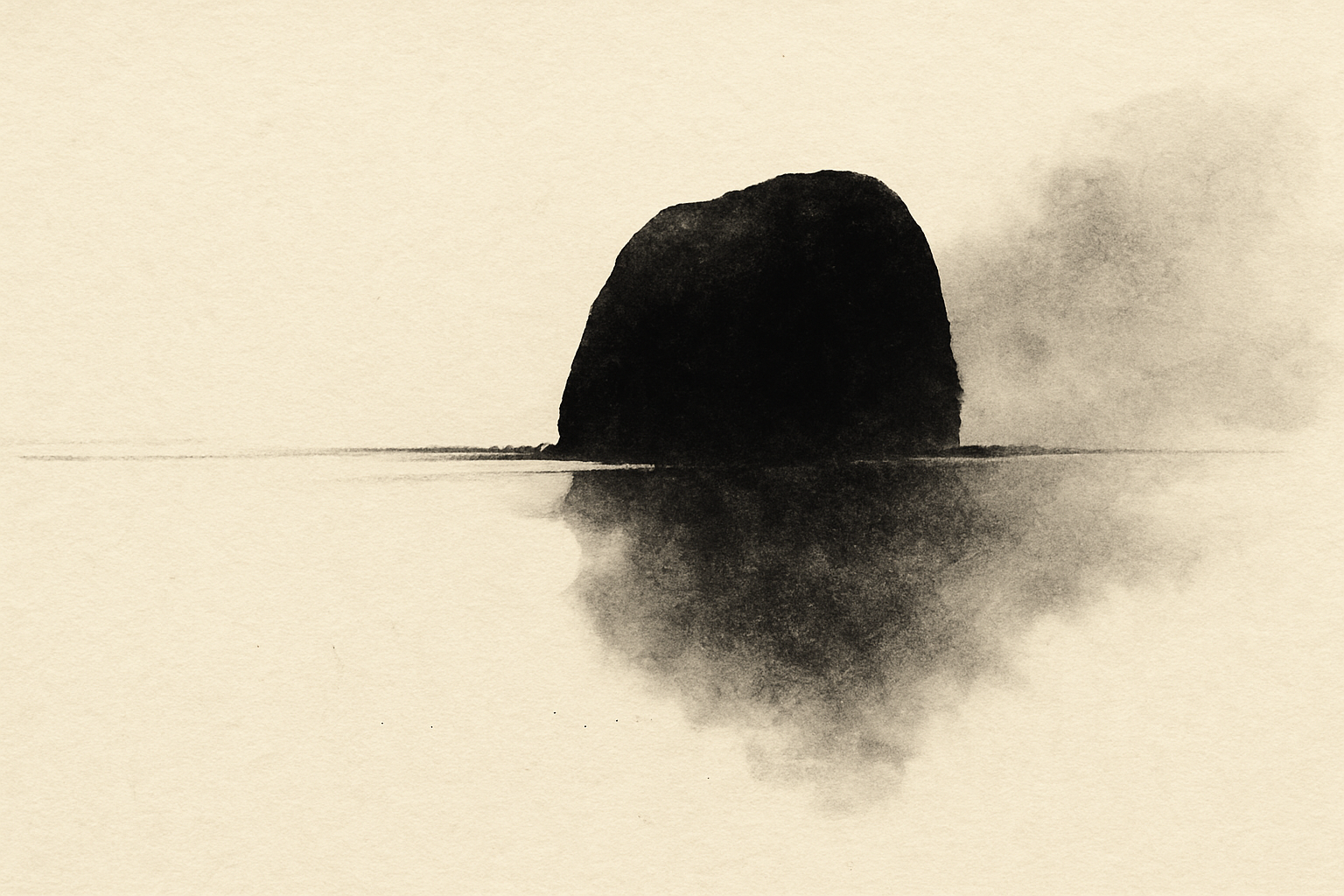
But is there really movement? In the meditation, I began talking about a lake as a metaphor for mind. What's happening in mind appears as a reflection on the lake. Everything reflecting on the lake, say the imagination of going to the moon and back, contains a lot of movement. But the lake is still.
I noticed that I am the lake, as the awareness of it, and then there's this movement of mind happening within that. I can have an experience where I'm following attention, grabbing that thought, but I can also have the experience that I'm the stillness of the lake while that's moving.
When you say "I'm the lake," I would say don't try to define yourself as anything that's happening or appearing. Just see it this way: the lake is a metaphor, obviously, but there is an appearance of reflection through imagination and thought, and that appears to move because it's changing, but it changes the way we see movement in a movie. There's a lot of movement in a movie, but is there anything actually moving? There's an interpretation of movement.
It makes sense to me somewhere. It hits something that resonates. And then there's this body experience of strain, the strain of that movement.
The belief creates the symptoms
That's because at a deeper part of your nervous system, there is still a belief, a paradigm of it being fundamentally real. So it has an impact in the biology, an impact in the nervous system. But then, because of the symptoms of the impact on your body, you assume that it's confirming the reality of it. It's the other way around. The belief in the reality of it is creating the symptoms.
It's like believing there's a leopard under your bed that's about to jump. Your body is going to be freaking out, literally having all the impulses of cortisol and fear and anxiety and heart rate changes, just from the belief that it's there. But having the body reaction is no proof that the leopard is under the bed.
So what I would say is, don't worry about the body sensations and reactions. Let that be an afterthought, the effects of something that's more at the level of how you're interpreting your experience. Try to address it at that level. The rest will resolve on its own.
And then what do you do about the belief part? How are you eradicating that?
The belief is undone by seeing the reality of it. The more you can see that the tension behind your eyes, all that strain, everything that appears to be moving and really doing so, all of that appearing to be real, the more you can see that it's just a veil of thought and there's actually nothing there other than imagination, the more you see that as imagination and thought versus the fundamental reality of your experience, that is the undoing of the belief.
It's like sort of just being the stillness as it's happening.
Yes, and being the stillness is also what happens when you see that the movement isn't really there. It's a bit of an aftereffect. The more you see what appears to be really moving as just images and imagination, the more the stillness is naturally there.
So your question was how to undo or drop the belief. It's the same with identification. It's all about seeing what appears to be real, what appears to be fundamentally how things are, and shifting by looking at it directly, noticing that what I thought was fundamentally real is actually interpretation, imagination, thought. To the same degree as the leopard or the ghost under the bed: when there is fear in the body, it's because there's a pretty strong belief in the possibility that there's a ghost or a leopard under the bed. It's fundamentally something that, to some degree, feels possible and real. Otherwise there would be no fear. As soon as I see there's nothing there, I can reflect entirely on the fact that it was just imagination.
That's pretty clear to me when I start investigating things like fear or uncomfortable sensation. But again, it's a mental doing. It's like, "Okay, I'm feeling the sensation. What does it feel like? Let me get in there. Oh, it's vanished." That whole mental process becomes its own thing.
Mind itself versus its contents
We're talking about something more subtle and deeper that has to do with the overlay of mind itself, versus the particular things that are appearing in thought. When we start working with this, normally we're looking at specific beliefs, specific interpretations, specific appearances in thought. Then we come to a point where that just doesn't do much anymore. We need to look at thought itself, mind itself. I think that's what we're talking about with you right now.
When you describe something moving in your mind's eye, something you can feel behind your eyes with a strain, that's the root of mind. To see that everything you're describing there is imagination itself, that is the lake itself. You say, "Well, I'm the lake." No. The lake is mind. What appears on the lake, the reflection, is mind activity. But you're not the lake.
It's not quite landing as something I know how to investigate specifically. I'm a little lost, because thought and mind is what I'm always looking at. How is this different from what I'm already doing?
Maybe try the exploration I was suggesting. Look at something, stay still (not forcing stillness, just gentle open stillness), and go back and forth between something you're looking at and a sensation located in your body, say in your foot and some object that's appearing. Spend ten minutes moving this experience between an object you're perceiving and a sensation. Then really look at it experientially. Look at what's actually moving when you notice the mind's eye.
Just noticing the mind's mental movement.
Notice what appears to be moving and look at the nature of that movement, with a genuine openness to the possibility that nothing is actually moving.
So even the mind movement is not a movement.
The movie theater metaphor
The mind movement is like having a TV screen where a ball is going back and forth. What's really moving? Think of it as a projector in a theater. The projector is actually showing still images, one after the other, projected on a screen. You're looking at that screen and you see a ball going back and forth. You think the ball is moving. But the reality of what you're experiencing is that you're just looking at a screen that is still. There's an appearance, an illusion of something moving back and forth, which are actually still images.
Your eyes would go back and forth on the screen, following something that seems to be moving. But it's all an illusion, literally an optical illusion. There is just light changing, a screen that is still, and there's this appearance of something big happening. When the movie is playing, one can get very emotional or scared, and there's nothing really there. Just colors and shapes and forms and sounds that came and went. At the level of emotional impact, we can jump in our seat in a theater, scared, but nothing really happened.
Bring that to the exploration of what it is like for you in the most simple, subtle thing. You don't have to look at something that's a big discomfort, because that's harder to do. Just look at your gaze on something in your field of vision and then go back and forth between that and a neutral sensation, like your foot or your hand, the perception of what you're looking at, and really explore what's actually moving.
Okay. I also noticed that whatever mind hears, it takes as a new philosophy and overlays it on top of everything, creating a new doing or not-doing. It's almost impossible to escape that except just to see that's what mind is doing. And then there's still this question mark: so who's doing my life? How do things get done? It still lands as either feeling passive or feeling like doing.
I'm aware that the mind is going to hear phrases and latch onto them. But the experiment I'm proposing, the one you're saying you'll just do, I think that's more powerful and more important. Those kinds of subtle things that you can see will bring clarity. Not intellectual clarity, but clarity in what your experience really is. That can start going at the nature of mind itself, versus working with the things appearing in mind.
Addressing the contents versus addressing the lake
Normally, when we begin this process, we need to address things that are appearing in mind, to resolve and clarify some things. Then we can start looking at mind itself. I think that's where you're at, and this is never a black-and-white thing. One can always go back and look at things appearing in mind. But at the level of this stage of clarifying, I think for you it's important to look more specifically and directly at mind itself. The questions you're asking ("What is doing? Who is doing life?"), those deep paradoxes, those fundamental enigmas, are a sign that the question has to do with mind itself.
Well, it's only mind that would ask that. So yeah, it's all on that level.
What I mean is that it's an important question, a valuable question, but it's a question going at the nature of mind itself versus aspects of mind. That question signals to me that what can be clarified for you has more to do with mind itself.
Mind itself as opposed to what, exactly?
As opposed to specific beliefs, illusions, and ideas appearing and held in mind. One can work on something like, "I'm really stuck and blocked in a belief that I'm just not able to get through this pain or this struggle." That is a particular belief appearing and held in mind and thought. If one is really stuck there, that's something that can be worked on, resolved, and clarified by removing the belief. But that does not address the issue of mind itself.
The questions you're bringing up, around bringing attention here and moving there, "What is this, and what's moving?", to me you're starting to go at the nature of mind itself and the limits of mind itself.
In the metaphor of the lake, mind is the ability to imagine, to reflect on anything in any way: pure, infinite imagination. On the surface of that lake, there are certain habitual appearances. I can always be imagining a leopard under the bed, reflected on the surface of mind. Or I can always be imagining some struggle, and that's always appearing as a habitual reflection on mind. I can start to work on that until I'm no longer distracted by the appearances of reflection. Then I can start looking at the lake itself. I can notice, "Oh, there's a thing here where reflection is happening," and start to understand its nature. Then I can look away from the lake entirely and look at perception and sensation directly.
It feels like a constant journey of doing both of those. I feel like I've been doing belief work for so many years, and it's always "I'm not good enough" or "I'm not safe" patterns. Under that is really this fundamental belief in separation, and that's the more elusive one. I wouldn't necessarily know how to work with it, but I try.
Where does the "I" appear?
This is how you work with that. Where is that "I" appearing?
In mind, but nowhere.
You have to look more closely, because that's a very quick thought response. Look literally in your experience. Where is it? It is somewhere. It's like the ball on the screen. You can say, "Well, it's not really there because I know it's not really there." No. Where is it appearing? How is it appearing?
It's always this sensation of a "me" contracted.
Wait. Sensation, or a "me"? How is the sensation of "me"? Those are two things.
The "me" part is the thought.
So is it the sensation or is it the thought?
It's more of the thought.
How is it the sensation? We said it's more of the thought, meaning it's partly the sensation.
The sensation is what reifies it for me. It's like, "Oh, that's real."
A sensation is real in the sense of (and now we get into the semantics of the word "real") it is appearing. It is something that is appearing, just as there are thoughts, just as there are sounds. But why is the sensation, to some degree, "me"?
It becomes "me" because it's like "me" is in this location, here in the body, looking out at the world. The sensation sort of justifies that that's true.
Can you see if that's maybe a preference or a choice?
I mean, I can easily switch, like the vase thing. I can switch to a perspective that's just expansive everythingness and I'm everywhere.
What actually switches?
Now look at exactly this. We're nailing it again. What switches?
It's the movement of the mind, right?
Is there something switching, really? Or is there an interpretation in your mind that something is switching?
From interpretation, yes.
It's like the vase and the faces. You're looking at it. It's not changing. And you think there's a big change: suddenly faces, suddenly vase, reality switching back and forth. Not really. Just a reflection on the lake, an interpretation. No real switching. No real movement. It's the same level of movement as me flying to the moon and back. I just did it again. It was fast this time.
But if your habit is to habitually still live in this "me here"... no, okay, I'm missing it.
You're going back to why you're attached to it and defending your position. It's not a habit. It's a choice.
A choice for which to see.
It's a choice to want to see things in that way or not, and to believe that it is so. What I'm trying to say is that the position "I'm stuck here because of habit" is not true.
Not so much to defend it, but just to explain what happens. It feels like it's habitually going back and then I forget and then I have to keep reminding myself.
It keeps happening because you haven't seen through it fully. And that is more of a choice.
To see through it more fully is to just keep feeling that?
No. To see. I'm talking about very specific things. It's not about going into feeling and staying with the feelings. That's not it. It's about seeing that where you have an idea, an interpretation, or for you this experience of movement, I'm saying there's no such thing. It's an imagination. When you say, "I can switch back and forth from the perspective of this and the perspective of that, I can go into the sensation, or I can be identified with the me here, or go into the non-dual," all of this back-and-forth movement is imagination.
I understand that part.
But look at it specifically. Directly contemplate it. Because I'm sure that for you it's almost experiential, like it's a big deal. There are these changes and this movement, and being in this way or in that way feels like a big deal with big changes and big impacts based on sensations or the struggle in thought. I'm saying all of that, all of that big-deal movement, is imagination. It is mind. It is reflection on the lake. If you see through that completely, totally, then there's really not going to be much impact. There's going to be nothing there.
Okay, because I thought I was hearing two different things, but now maybe I'm hearing something different. I thought you were saying to investigate that movement and see there's nothing there, but then also to see that I'm choosing one particular movement.
You're choosing to be struggling between the movement of what you are and what's moving, what's changing, who's doing it, where it's going.
I don't think so. That's what mind does. If it thinks about the story of me, it's like, "What am I doing with my life?" But I don't spend too much time there.
What I'm talking about is the actual struggle you described: going into the sensation and moving, but then it's "me" being identified, and it's the "me" sensation, and then you can switch to the other perspective. There's still this involvement in all of this complex dynamic. That's what I mean by struggle. That's the thing you're chewing on, and that is mind.
It all started from your question about investigating the "I," and that is the pattern of what happens when I try to do that.
The edge of thought
What I'm actually trying to say is something positive. The work you've done has brought you to the edge of thought. You're no longer (to put it in more black-and-white terms) too involved in what's appearing on the reflection on the lake. You're at the point where the thing coming up is the issue of the lake itself, the nature of the lake.
I might be a little too generous. I still think I'm involved in the appearances.
I'm aware of that. I'm saying this intentionally because it's come up quite a bit today. All these little signs point to the fact that the thing you're going at, the thing that's tricky for you right now, has to do with the nature of the lake itself.
I see that part. I just didn't want to give myself too much credit. I'm still lost in other stuff.
Give yourself the credit to have the possibility, a real possibility, to be free. That is a real possibility now for you.
Just hearing you say that, immediately I'm hit with freedom. It's here now.
True freedom does not come and go
But if it's ever lost, it's not here. Some flavor of it is here. I'm sure what you're talking about is real. I'm just saying that more total freedom, true freedom, cannot come and go. Once it's here, it's always been here and always will be. Again: movement. If it's coming, it's going.
The coming and the going, and then there's awareness, stillness, that's not moving.
I think that's the contemplation for you. Because even when you say "awareness, the stillness, what's not moving," it's the same as what I said about freedom. Once you see nothing's moving, it doesn't go away.
Through your suggestion, I feel like I can play on the level of the mind, just keep noticing what it is that I'm taking to be movement.
You're flipping back and forth between polarities: dual, non-dual, this and that, stillness and not-stillness, freedom and not-freedom. That's the edge of mind. All of that movement is only possible in the mind, and it's not true movement. It's an appearance of movement. For you to contemplate that, in the stillness of contemplation, in your own experience: there isn't much more to dialogue on at this point.
I hear you. Thank you. Even the word "contemplate" is a mind activity, so I don't even know.
Whatever works for you. Whatever works.
Hasn't worked yet, but I'll keep investigating. I appreciate your help.
You're welcome.