The Stone in the Marketplace
La Piedra en el Mercado
A student asks about the tendency to grab onto familiar phrases and pointers as crutches for reaching a state of not-knowing, and whether it's possible to simply rest there without any aid.
The Stone in the Marketplace
A student asks about the tendency to grab onto familiar phrases and pointers as crutches for reaching a state of not-knowing, and whether it's possible to simply rest there without any aid.
I've noticed this tendency to grab onto something, a phrase, a map, something that's helped me in the past reach that place of not knowing, of letting go of thought. It feels hard to simply not know without grabbing onto any crutch. To know that I know nothing at all, that I don't need any aid, any phrase. Even when it's something that has helped me in the past. Is it possible to settle in that place of not knowing?
What matters is to notice how much the sense of dissatisfaction or something missing appears, because it's not so black and white.
You know how when watching movies there's something called the suspension of disbelief? It has to do with believing the experience, believing the thoughts or the interpretation, in order to have a certain experience in the movie. If you don't buy the narrative, the story, the actors, you won't really enjoy the movie. So as a metaphor: what's the point of trying to live in a state of not believing anything and not knowing anything? It's all about enjoyment. It's all about peace, well-being, happiness. This has been talked about many ways and called many different things.
So I can function with beliefs and certain kinds of knowings. It's more of a movement on a spectrum. The moment there is something with the taste of dissatisfaction, of something missing, of the absence of the peace I'm familiar with, then I can look at it. Over time, it becomes very quick to notice what it is and the belief underneath it, the thought pattern. I can see, "oh, that's just that thought, that belief," and it dissolves quickly, because there isn't usually attachment to it.
The shift in identity
That kind of freedom becomes possible after a certain shift that has to do with identity. It can happen progressively just by working with beliefs, but a bigger shift happens when the seeing through identity itself happens more and more deeply. I'm trying to undermine the sense that you have to always be in a state of not knowing.
It really depends on how you experience life and yourself. If you're enjoying life, that matters. Although one can be enjoying and believing oneself to be enjoying while in a delusion, where everybody around you has problems with you and you're upsetting and hurting everybody, but you're having a great time. That's a sign of a disconnect with reality. So life is a mirror as well. Just to avoid the sense that one can settle into a belief system that one is fine and okay with everything, when actually one is not. The mirror to that is life and others, how others experience you and how life is going for you.
Whack-a-mole
The matter is not so much about trying to not buy into any belief, because that's like the game of whack-a-mole. As soon as you push the mole down in one hole, it comes out in another. You push it down, it comes out somewhere else. Trying to look at every belief and disbelieve it has this perpetual quality.
So you find antidotes to certain beliefs. When you notice a belief, you have a pointer that has helped you with it. Then that pointer stops working, because in a sense that belief has been dispelled, and now it's no longer bringing you to that openness, because some other belief is taking place. Now you need an antidote to that other belief. That can be pretty endless.
The ultimate antidote is the relativity of self, the seeing through of any belief that begins with "I am." Then you can operate with certain kinds of beliefs, like the suspension of disbelief in a movie, where it's smooth to function, letting some interpretations of life become reality.
The beliefs about self are the ones that, a priori, feel tight and create problems. That's where the whack-a-mole happens, because beliefs about self are endless. The mind will constantly recreate itself. That's an infinite process. It will never end if you're trying to dismantle it by removing beliefs, because it will be constantly recreated with new ideas, new thoughts, new interpretations.
I think I've had the experience of those beliefs appearing and being okay with it because I don't believe they are me. It feels light. So it's about how not to fall again into believing it is what I am.
You're interpreting the mechanics of it as "falling into something." See it more as a choice that's happening right now. Only when there is some form of distress, when there's that experience of something tight and unpleasant, something missing, the absence of the peace you know, look at it as a choice rather than a falling.
Yeah, not as something that happens to me, but...
Yes. Because the interpretation that "I fall and then I find myself again, I get up again, I find clarity again," points to a process in time that you can get better at, until eventually you arrive somewhere settled. All of that is thoughts. It's always happening now. There is a belief, and there is a choosing of belief, every moment, right now.
Anytime you find yourself in that sense of tightness or struggle, notice the belief in a process that will get you to the end of that struggle. Instead, notice that right now you're choosing to believe something is missing. You can drop that. Not by forcing it, but by seeing that you do not know. It's an interpretation.
Where dukkha gets projected
In the meditation, I was pointing to the two places where we tend to project dukkha, something missing, dissatisfaction. It's either in the space of sensations, in the body, or in thoughts and emotions, which are basically all thoughts. They're connected. It's either something I'm feeling in the body, sensations or emotions that should be different, or something about how I'm interpreting life and circumstances that should be different.
We don't normally experience dukkha, the sense of absence or lack, in what we're seeing or hearing. That's not usually where it's at. It has to do with what we identify with: the body, and the circumstances we're in, our interpretation of life, past, future. So it's going to be body, health, relationships, work situation, family situation.
When we have the sense of something missing, it's only ever based on what I call a belief versus a fact. A fact could be: I'm experiencing pain in my left shoulder. The belief is: I'm not okay because of the pain in my left shoulder, and I will be okay only when the pain stops. That's very different. It's a belief because we haven't yet explored the possibility that I can be fully, totally okay with pain in my left shoulder. It's based on an assumption that in order to be okay, the pain needs to stop. This is the hardest belief to challenge. And it's the same wherever it gets projected: the body, sensations, health, work, living circumstances, relationships, family, friendships. That's where we find and project the belief that something is missing.
The separate self and the sense of lack
I'm trying to tie this together, because I have the sense that "something is missing" is very tied to the belief in me being a separate entity. Can you say more about how it's tied?
Exactly. It's one thing with two sides, like a coin. You can talk about it from one side or the other. To have a sense of a separate self, you need to imagine an entity. The mind creates the person, the personality.
I'm trying to remember, because it's a bit hard to find in my experience right now, but when that image is believed to be what I am, the only way I can fully believe it is if something is missing, if something should be different in how things are. It's like the whole reason for that entity to exist is to make things better, in a way.
I would say it's not to make things better. It's to react to what I think should be different. Because making things better can come from the heart and from a universal response.
What is at the core of it, at least how it was for me, is a kind of arrogance. "I know this should not be as it is." It's a position: I am not okay, and this is not okay because of how things are. It has to do with an opposition to life, to reality.
Yes, there's the connection. I see it better now. That's different from what I was pointing to in the meditation, and different from what you mentioned about wanting things to be better, which can come from complete openness. Acceptance, not as a doing, but as the seeing of the reality that things are as they are. I have no evidence, and I do not know, that they have to be different. This could be perfect as it is. At the same time, I am part of this reality, I am this reality, this creative experience. So I can play with it. I can bring heart, bring wisdom, bring a trust in my insight, the wisdom that this could be better. But now it's coming from a creative process.
The painter and the canvas
It's like being a painter or a musician. You're a musician. Think of it as: I'm in the middle of a creative process. I'm painting a wall, or I'm writing a piece of music. If I'm looking at the painting and seeing it as messed up, "this is wrong here," then maybe there's no way to fix it. I have to fight with what's on the canvas. Versus: the painting is in the state that it is, and I can interpret it as given to me by life, or as where I am in the process of painting. The second interpretation is closer to reality.
Then I'm just working with the painting, with the colors, to shift it toward my highest taste, my experience of beauty and creativity and love, my vision of how it could be better. Same with a piece of music. Instead of seeing what life is presenting as messed up, as wrong, as not okay, I see that I am the creator. Or I can interpret it as: this was given to me, and I can play with this music, this painting, this sculpture. Working with it exactly as it is, is the deepest way I can shift it endlessly, which is what happens in life. It's an endless shifting, co-creating, dancing with what's happening, from a place of totally seeing the beauty of what is in the moment, even the parts I can see could use my help.
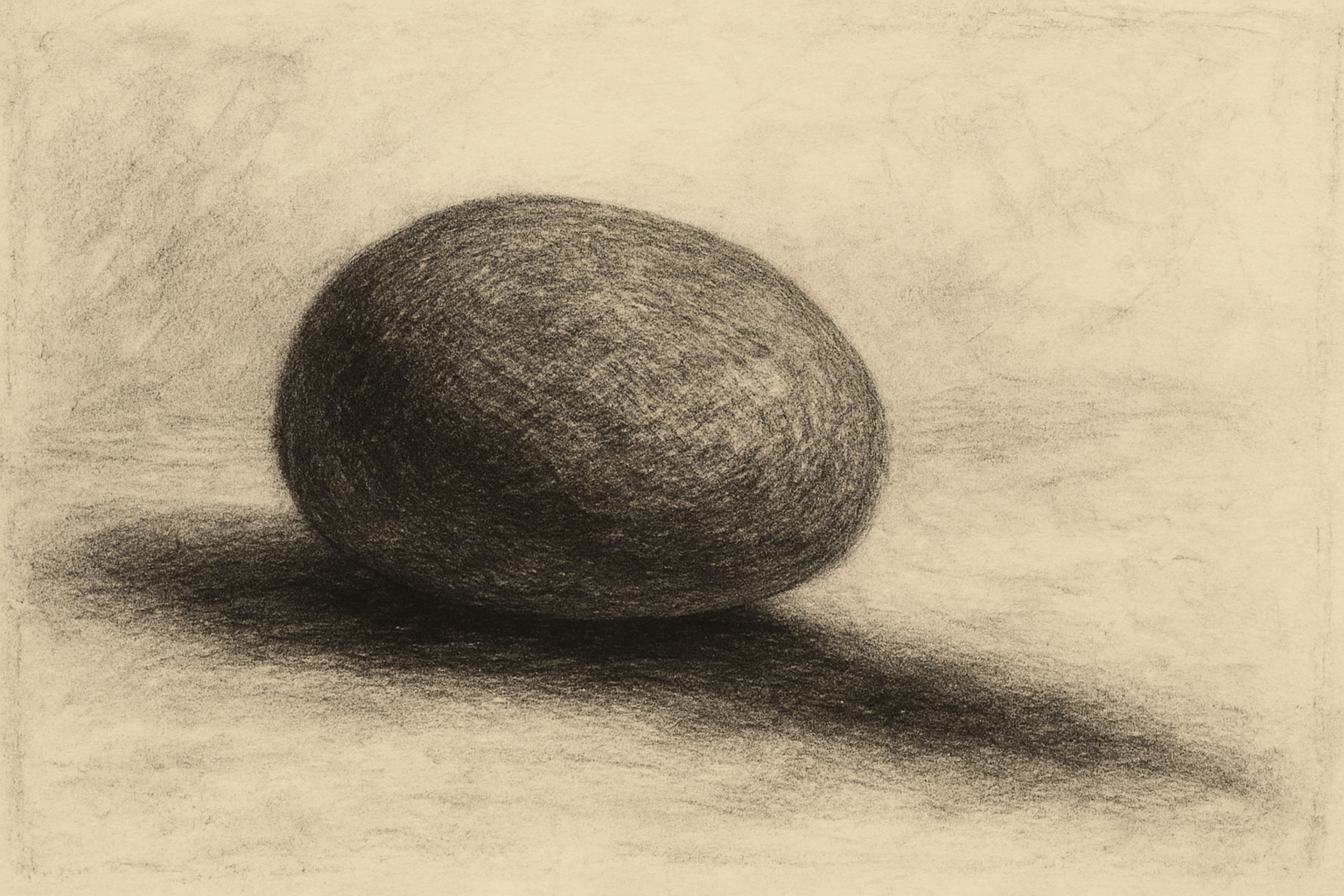
Yes, it's a beautiful metaphor. It reminds me of the story of Michelangelo finding a stone in the marketplace. The way I read it, he saw this stone someone was throwing away, and he already saw it as beautiful and perfect. Then he worked with it, removed the extra parts, and made the statue. He saw it was already beautiful from the beginning.
Exactly. That's the experience. That's where the awake experience is, at least how it shifted for me. There was a before and after.
Before, there was always something not okay with what is. There was always something missing. Looking at the painting of everything, including my thoughts, my emotions, my circumstances, there was always something. I had favorite places. If my knee wasn't in pain, I had to find something else, like my work situation. If my work situation wasn't a problem in this particular moment, I'd find something in sensations or somewhere else. There were always these four or five, or twenty, but usually at the end, two or three preferred places where there was always something not okay. Whenever that settled, because right now there was no problem in my sensations, the other preferred place would take over. Always finding something in the painting of what is, because the painting is always moving. "That blue on the top there, that really is a problem." There's something wrong right now because of that.
It comes from "I know." Universal manifestation is happening, but I know there's an error here. I know that's the error, and I'm not okay because of it. Versus: wow, this is mysterious, infinite creation, with all of the colors, all of the flavors, some more pleasant than others. And I can no longer rest in "I know," because I don't know. I cannot know that this painting has a problem. And also because I see beauty where before I saw a problem. I can also see where things could shift, though the use of "I" there is a bit weird, because it's life.
The arrogance and the wisdom
The metaphor you brought of Michelangelo is perfect: illusion, ignorance, and Buddha nature. The one throwing out the stone had a belief that it was not okay, not valuable as it was. The arrogance is: the owner of that stone in the market threw it out thinking, "I know this stone is not good." Whereas Michelangelo saw the stone and saw the beauty in it. That was wisdom, and in fact the truth. Metaphorically, who was right? Michelangelo was right. He saw beauty there and was able to bring it out. All of this is a metaphor for this moment, this reality, what is happening right now. It's not about tomorrow.
Yes. Thank you. A beautiful conversation.