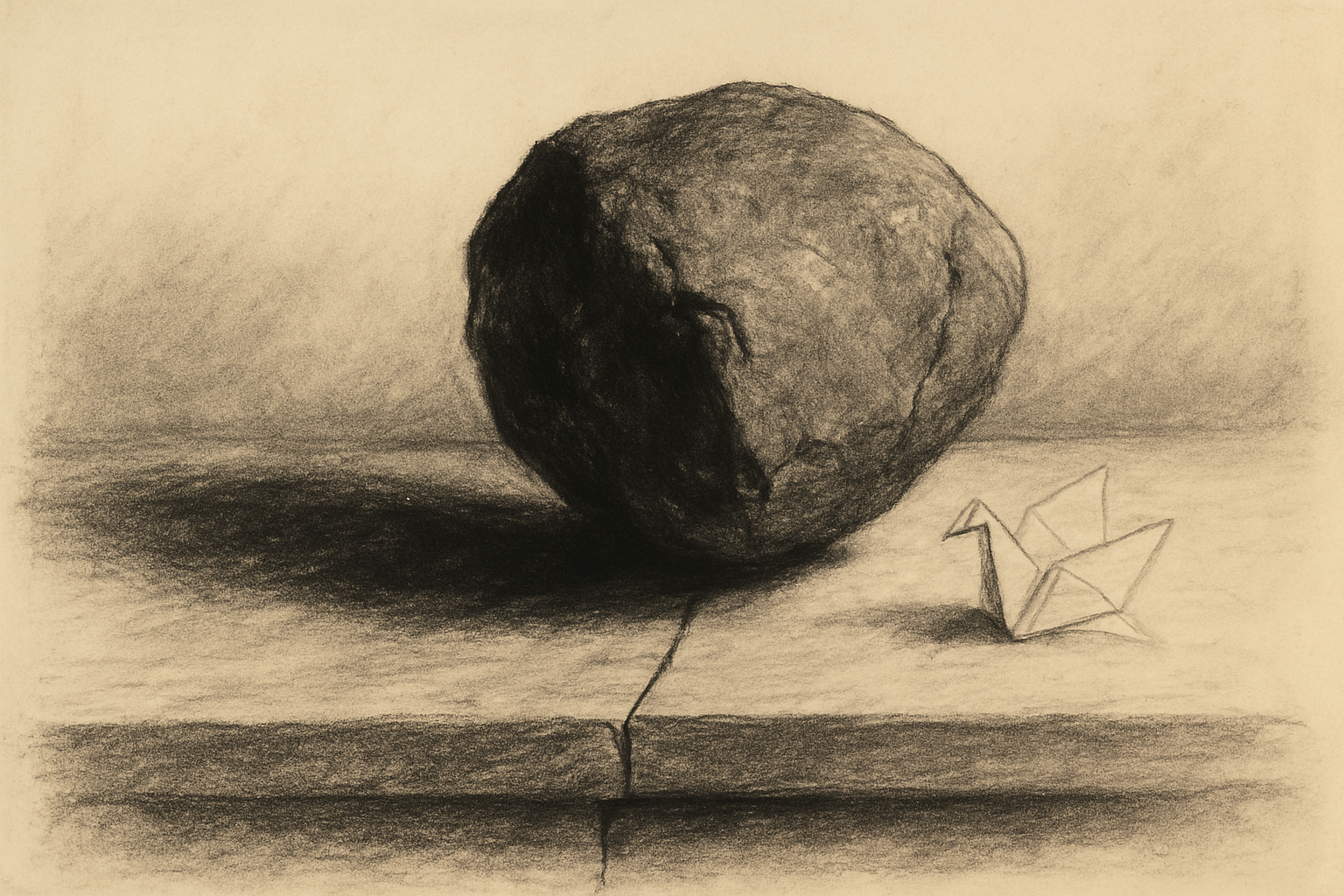
The Toy Soldier and the Image of I
El Soldadito de Juguete y la Imagen del Yo
A conversation about the fear of what might be lost through awakening, the futility of imagining the future, and how we mistake the constant motion of thought for a real self.
The Toy Soldier and the Image of I
A conversation about the fear of what might be lost through awakening, the futility of imagining the future, and how we mistake the constant motion of thought for a real self.
I keep thinking about this over the last few days. I remember being promised, "Just believe me, have faith that it's better." And every time I think about where you are now and how you talk to us, I wonder: why would you talk to us if you were leading me down a bad path? I feel I can at least trust in your love.
It really is about trust. When I say it's something I could never have imagined, it's not necessarily because it's just so wonderful. It literally cannot be imagined. It's beyond the faculty of imagination. It's beyond the faculty of thought. And I would never go back. No interest.
Are there people who realize and then want to go back? Like the guy with the steak in The Matrix? Am I in the spot where that guy wanted the steak?
You're in that spot, yes. He wasn't realized.
Okay, that's a relief.
The comfort of keeping things as they are
Notice how when I said things could be exactly as they are right now, you said, "Oh, that's nice." Why is it nice?
Because I get to keep what I know. I don't have to lose my family. I still have my things. I know I'm attached to things. I have familiarity, a sense of comfort, control, calm. I'm not sure those are exactly the right words. But when you said that, it didn't feel scary.
Just watch when you scare yourself with images of what it would be like, because it's not going to be that either. You can't imagine the positive or the negative. The imagining of what you're going to lose is also a way to energize your resistance, because it's false. It's just more thoughts, more pretending to know what it's going to be like. The best way to imagine what it's going to be like is exactly what is happening right now. It will be exactly like what is happening right now, at every moment. What changes isn't at the level of experience. You could be sitting exactly how you are right now, with your life exactly as it is.
That sounds nice.
All of the problems you have right now, all of them, yes, they are still there. What changes is a change at such a deep level you cannot imagine.
Nothing new appears
There will be shifts, possibly in your personality and very likely in how you function. But the mind, the thoughts you have, the mind doing its thing: it will still be doing its thing. What really dramatically shifts is very subtle and fundamental. It's that sense of what I am. But nothing new appears. Our being already is. We just stop believing we are something that is just thought. I can still think about myself. I can think about anything I thought about before. It just no longer confuses me about reality. When I think about myself, I don't experience that as what I am. Think of an elephant. When you do that, do you feel you are an elephant?
No. I can feel some of the elephant, but I don't feel that I am the elephant.
It's the same thing. I can think about myself, but it's like the elephant. It's just clearly an image. And because I'm not trying to constantly convince myself that I'm that, I'm not thinking about it much, only when there's some need to plan or function. In a conversation, there's the image of "I" and the image of "you." But the sense or the experience of being is not that image. It used to be.
I don't fully understand what you're saying, but what I can say is that the way I think feels very burdened. Things feel harder than they should be, because of the over-identification.
That's just how things are. It could be easier, but not before it's probably harder. Just keep looking. Notice beliefs and thoughts, especially about the future and how things will end up in this process. Know that you cannot imagine it, neither positively nor negatively. Anything you conceive of it looking like: notice it's just thoughts.
Thank you.
---
I'm trying to understand the mechanism more. I feel identified with some of what was just said, particularly around money issues. I'm in a low season, and I got together with a friend who is also a musician. He's doing really well, and he likes to talk about it. I started comparing myself, going into this negative spiral of feeling afraid, suffering, telling myself how incompetent I am. But I'm trying to connect this to what you were saying at the beginning. It's as if this sense of "something's not right, something needs to change" is constantly projected onto one thing and then another. Sometimes it's this, sometimes it's that. And I really convince myself: "All I need is this one thing. If only I had that, I will be okay." I do believe it, because I suffer from it.
Separating ambition from the search
You believe that getting that thing is going to resolve what I would call suffering. You do need to do your best. This is where it's more about life advice: how to function better, how to live better in every way. And then there's the question of what we truly want, our deepest, truest desires. And then there is waking up. The confusion happens when we believe that if we live better, if we function better, if we get better at something, we arrive somewhere that's getting us closer to waking up. In a way it can, but it's not a good strategy. It can in the sense that it can frustrate us more. If we get everything we want, we will likely get more frustrated and suffer more.
That's actually one of the suggestions from Osho. He says the apple falls from the tree when it's ripe. But it's still a tricky strategy. He was essentially balancing out the traditions of spirituality, especially in India and Buddhism, which are all about abandoning desire. For him, and I agree, that simply doesn't work. You can't starve desires. So he was advocating for a contrasting path: develop the ego to its end, and then it will fall naturally. But I would say that's a good teaching for when somebody is collapsed on the other side. One way to look at it is: work on both, or find the middle path.
What that leaves you with is what to do with your life, how to live, what to work on, where to put energy. Excellence. Do as much as you can in the best way possible, but knowing that it's not going to get you what you want. Not in the deepest sense of what we're talking about here. So then it's no longer a strategy to satisfy a deep sense of unrest. You've completely separated the two.
It sounds good, because it's as if I could decide to be more alert to the idea, to not believe that doing certain things or getting certain things will give me what I'm looking for.
But it doesn't mean stop doing those things either. In fact, you can put more energy into them.
I usually feel better when I do that. Thank you.
Watching what thought creates in the body
Notice the experience of what imagining the future elicits. For example, if you imagine, "If I do this and I develop in this way, where am I going to get to?" you are creating an image of a future. You are creating time, creating a path, a process. It's all the mind. But it's also going to create sensations, textures. In the feeling body, the emotional body, when you imagine, "If I achieve this image of what I'm thinking," it's creating not just images but textures and sensations.
When you're doing that, don't just stop doing it. Look more closely at what is being created. Look at the textures, because usually what happens is we imagine something and then we forget it's imagination. It starts to become subtly real, something "over there" in the future. And it becomes energized by something. That something is the textures of sensation, emotion, and feeling that the imagining creates.
To do this consciously is to really expand your awareness to everything you are doing. Then you can look more closely and see that what feels so real is fully imagination, fully images, fully mind-stuff, emotional stuff, and texture-sensations in the body. You'll be able to notice: "When I'm imagining this, I'm creating a sensation of anxiety or fear. When I'm imagining that, I'm creating a mix of anxiety, fear, and excitement, and it's actually pushing away a sense of loneliness or emptiness."
When you go into thought, you can start to notice all of what it's doing, all of what you are doing, and what's energizing it. It is going to be a form of manipulating your current experience: creating sensations you're more comfortable with, covering up sensations you're less comfortable with. Ultimately, it's about filling a space that creates a sense of a center, a sense of a stable "I" here. If you start to see that whole thing fully, you will notice that there's a kind of instability there. A kind of quicksand. A spaciousness, a voidness, an emptiness. That's the direction to explore.
The ending of hypnosis, not the ending of thought
This process doesn't stop envisioning, imagining, and planning. What does stop is the hypnosis. By that I mean: thoughts are real, but they are real as thoughts. What ends is the hypnosis that there's actually a thing in the future, that there is time in the way we imagine it, and that the image of "I" there is really what I am. It becomes just a way of operating. Then there is a real relationship with mind, with thoughts. I look at the coffee cup and decide to grab it. I can imagine "what if tomorrow" this or that. But I know that before, there used to be this real sense that something of it was real: "I" in time, "tomorrow," "I" in the past. Now there's only what we can call the present moment.
To me, "present moment" used to sound almost absurd, because before it seemed like there were many moments: past ones, future ones, and this tiny little one in the middle. But I would say there's reality, and then there are thoughts about time, past and future, happening in thought. Then you start to see there's nowhere to go, because you can't go anywhere. Not as a bad thing. It's just freeing. Where are you going to go? It's always present, always right now.
There's something about that which is really relieving.
You're present with something very profound. It's that which you're in touch with, which called you to this work. If it resonates, that's a really good thing. Then it's this dance with presence. It's intimate, infinite, mysterious, constantly moving and changing. As traffic flows outside, thoughts also flow here. There's this dance, and because of thoughts flowing, actions happen, choices are made. If ever you feel stuck or confused about what is real, it's always about what is happening in thought that you believe to be something other than thought.
Thought as a mirror of reality
What do you mean, as a way of differentiating?
It's a way of relating to what is. What happens is that we relate to thought and then start to believe, more or less, that those thoughts are reality. As a metaphor: if I have a toy car and I start to believe it's a real car, like children do, I'm attributing reality to it. You get a doll or toy soldiers and start to imagine the reality of it, and you think those toy soldiers are real soldiers. That's a great faculty we have. But then we lose the ability to see that it's imagination.
It's a good thing to be able to do that consciously. When we see a movie, we do exactly that. If we're not able to do it, we can't enjoy the movie. But in watching a movie, it's done consciously. We don't fully forget we're sitting in a theater or on a couch. They call that the suspension of disbelief. But we know it's not real. We experience the movie as fully as possible, and it's a conscious choice to go into it. Same with a child playing with a toy: it's a conscious choice, and the child can fully play with the fantasy.
What happens is that we grow up, and there are aspects of that imagination where we forget we performed a suspension of disbelief. We now constantly believe it is real.
Seeing the nature of thought
How can you tell what is real and what is not? The challenge is to see the nature of something. If I look at a toy soldier, to see what is real is to know that it's a toy, not a real soldier. With thoughts and imagination, it's the same: to see that they are thoughts, to see that it is imagination, to see that it is emotion, which is sensations and textures in the space of the feeling body. It's not a real thing in the sense we usually mean. It's real only as emotion. It's real only as thought.
I understand, but do we have control over that? If we're believing a thought to be real, we're there, unless we have an "aha" moment and see it's not real.
You have control through practice. You trained yourself to believe that, and you can untrain yourself. You did that all on your own, with the help of your parents, while growing up. Now you can undo it. The practice is what I'm pointing to: see it for what it is, the world of thoughts.
The three components of thought
The world of thought is basically a reflection of reality, and it's composed of three things. First, sounds: imagined sounds, sounds only in the mind. Second, images: imagined images, only in the mind. Third, sensations that are imagined, only in the mind. Those sensations we call emotions. That's it. The images are based on concepts like a chair, a circle, a person, a planet. But it's basically images, sounds, and sensations. What is needed is to see the true nature of what that is. I'm telling you what it is: it's thoughts. By that I mean images, sounds, and imagined sensations. It's as if they have a quality called "thought," and you learn to identify that quality. Then you stop confusing it with reality.
The image of I
When we are growing up, our mind develops the ability to imagine. It's fascinating, miraculously fascinating. It's a universe that is all your own playing. But what happens is that we forget we're imagining. We forget the nature, the essence of what it is made of: the substance of thought. That substance is different from direct experience, though we can say it's all consciousness, all one field. But if we are trying to discern, there is the experience of direct, raw sensation, the experience of sound and sight, and then the aspect of mind, which is what I call a mirror, because it's also sound, sight, and sensation, but imagined. It's happening all in one space, one field.
Just as you can distinguish sound from sight, you don't confuse sound with sight. Some people have synesthesia, where pathways in the brain mix: if they hear a sound, they might see visuals. But even they can distinguish sound from sight if they learn what synesthesia is. In the same way, it's all one field, but you can distinguish images of the mind from images of sight.
That's what meditation trains you to do. Look at the mind. Pay attention to the sensation of the breath as what is real, in the sense of "not mind." Sensation of breath, not mind. Body, not mind. That's the first training. Then, to be able to see constantly what is thought, what is image, what is sound, what is imagined sensation and emotion.
If I really see what you're saying, it stops.
And we usually become able to do that, but temporarily, for moments. Those are our hobbies, the moments in which we flow, or when we get something we want and give ourselves the taste of pausing that activity for a bit. But there's still an underlying belief, still this imagining of what I am that feels real.
The belief is what makes the toy soldier into a real soldier. That's why it's called the suspension of disbelief, when you do that consciously. The core of this whole thing is that there is an image we created from very young, which we believe to be real like the toy soldier. If we believe in the reality of the soldier, it's no longer a toy. And that's the image of "I." We create an image of "I," what and who I am, and then we no longer know it as a thought. It becomes really what I am.
The weird thing is, if you look closely, it's not one image. It changes all the time.
Exactly. It's a constant movement of thought. You're identified with many images. That's true. Saying "the image of I" is a simple way to talk about it. But the actual experience is a constant motion of images, of sensations. Mind is constant motion. If we are attached to the belief that this image of "I" is what I am, then we have to constantly recreate it, because if we stop, we feel that we disappear.
Really, all that is needed is to look at thought, see it as thought, nothing more than thought, all the way to the core, which is the thought of what I am. It's going to be a constant motion of images. The more you see that, the more it's all going to unravel by itself.
Thank you for all the great insights.
You're very welcome. Thank you for sharing.